Project
Soft Magnetic Ferrites for Next-Generation Power Electronic Applications

Project
The next generation of power electronics is heading towards operating frequencies in the GhZ range. This will require engineering of materials better than the current state of art having enhanced magnetic and electrical properties, consequently attaining lower losses and enhanced performance. The current state of the art technology involves grain boundary engineering of Mn-Zn/Ni-Zn ferrites using magnetic/non-magnetic insulating oxides for property enhancements.
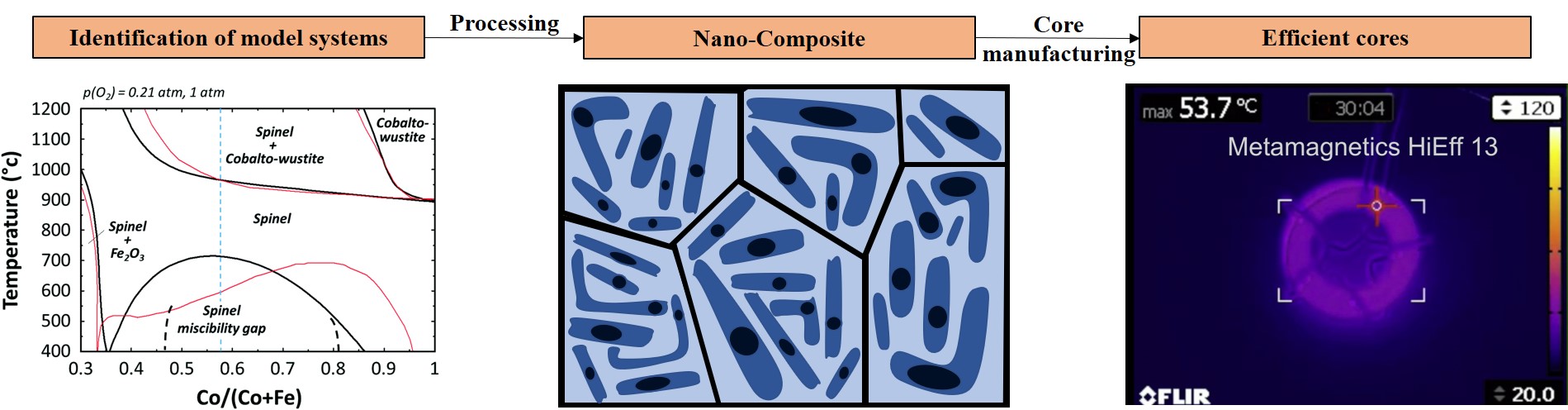
We aim at achieving further enhancements by nano-structuring the Mn-Zn and Ni-Zn ferrites to create nanocomposites. Nano-structuring of these ferrites will be induced either via a self-assembly processes or by the application of external stimuli during processing. Thermodynamic modelling using Thermo-Calc is carried out to identify model systems which are suitable for this approach. Effect of external fields i.e. magnetic, isotropic stress etc. during processing on the microstructure are being investigated and will be compared to thermodynamic and kinetic modelling results. Leveraging self-assembly/nano-structuring of these ferrites will help us develop materials with lower losses and operating capabilities at Ghz frequencies.