Project
Quantum Sensing with NV Centers in Diamond
We use nitrogen-vacancy centers, atomic-scale defects in diamond, as quantum sensors for magnetic fields and temperature.
Ongoing
Project
We use nitrogen-vacancy centers, atomic-scale defects in diamond, as quantum sensors for magnetic fields and temperature.
Ongoing
Local variations in magnetic field and temperature inside materials, devices, and energy systems can reveal how these systems behave. Our research uses nitrogen-vacancy (NV) centers in diamond, which are atomic-scale defects that emit red fluorescence under green laser illumination and can serve as quantum sensors. When microwaves are also applied, the intensity of this fluorescence changes in a way that depends on the local magnetic field and temperature.
We develop optical and microwave measurement techniques to reliably detect the response of these defects. The ultimate goal is a compact quantum sensor that converts this response into accurate measurements of magnetic field and temperature. Potential applications range from materials characterization to the monitoring of devices and energy infrastructure, where local magnetic and thermal information is valuable.
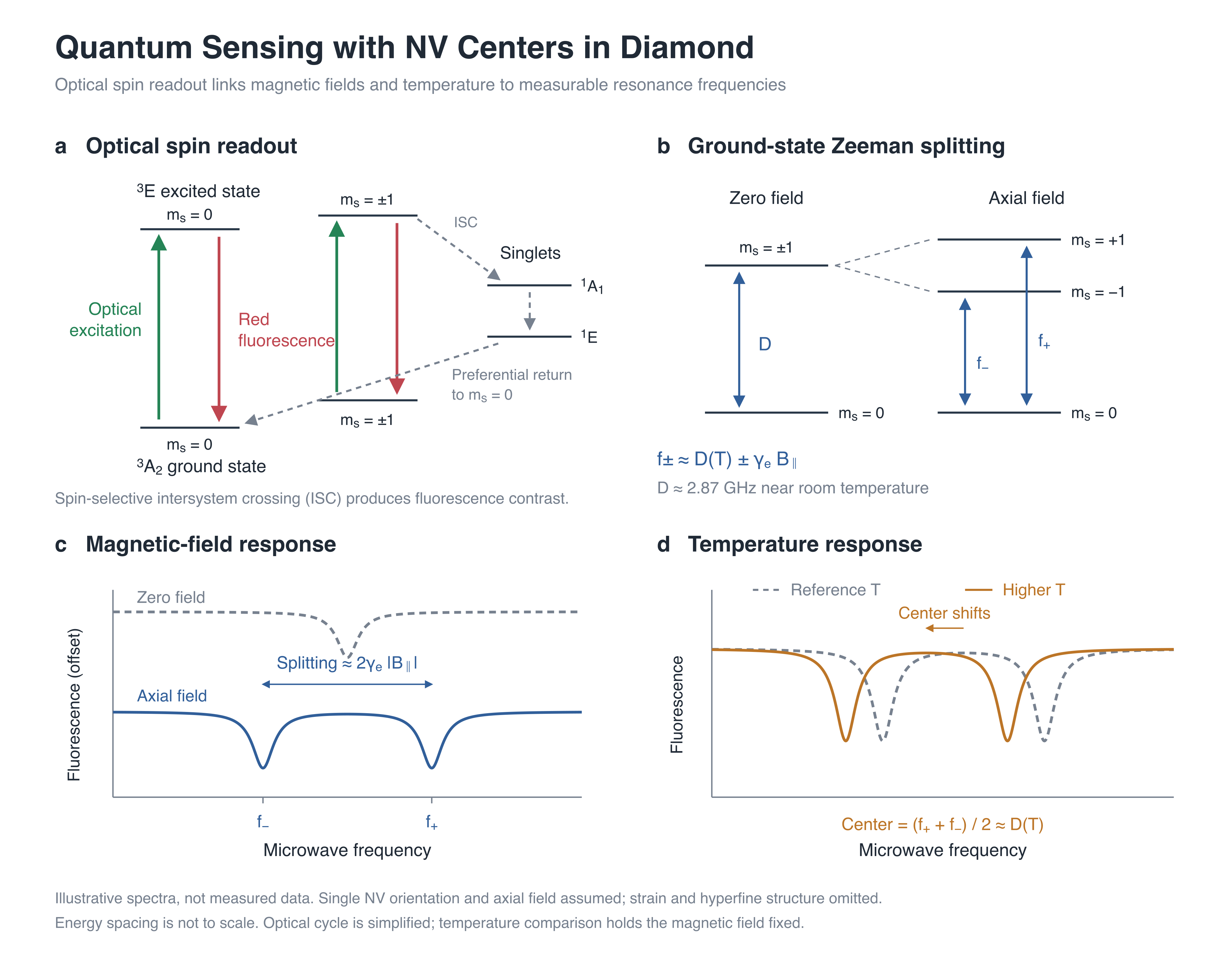
The sensing element is the negatively charged nitrogen-vacancy (NV) center in diamond, whose spin-triplet ground state has a zero-field splitting of approximately 2.87 GHz. The spin sublevels are probed by optically detected magnetic resonance (ODMR). 532 nm laser excitation initializes and reads out the spin state, a swept microwave field drives transitions between sublevels, and resonant transitions appear as reductions in the red photoluminescence. An external magnetic field splits the resonance through the Zeeman effect, while temperature shifts the zero-field splitting, providing the physical basis for magnetic-field and temperature sensing.
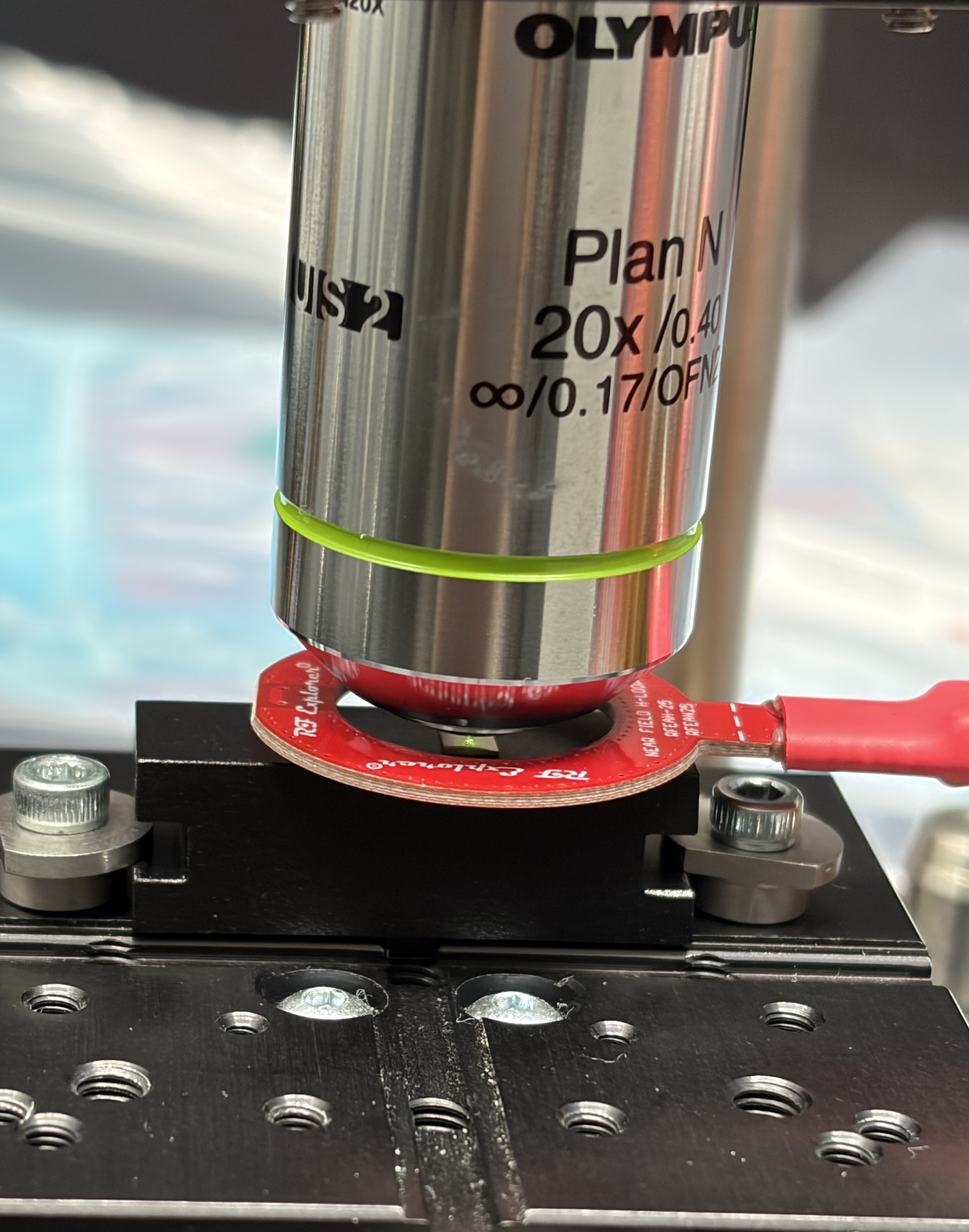
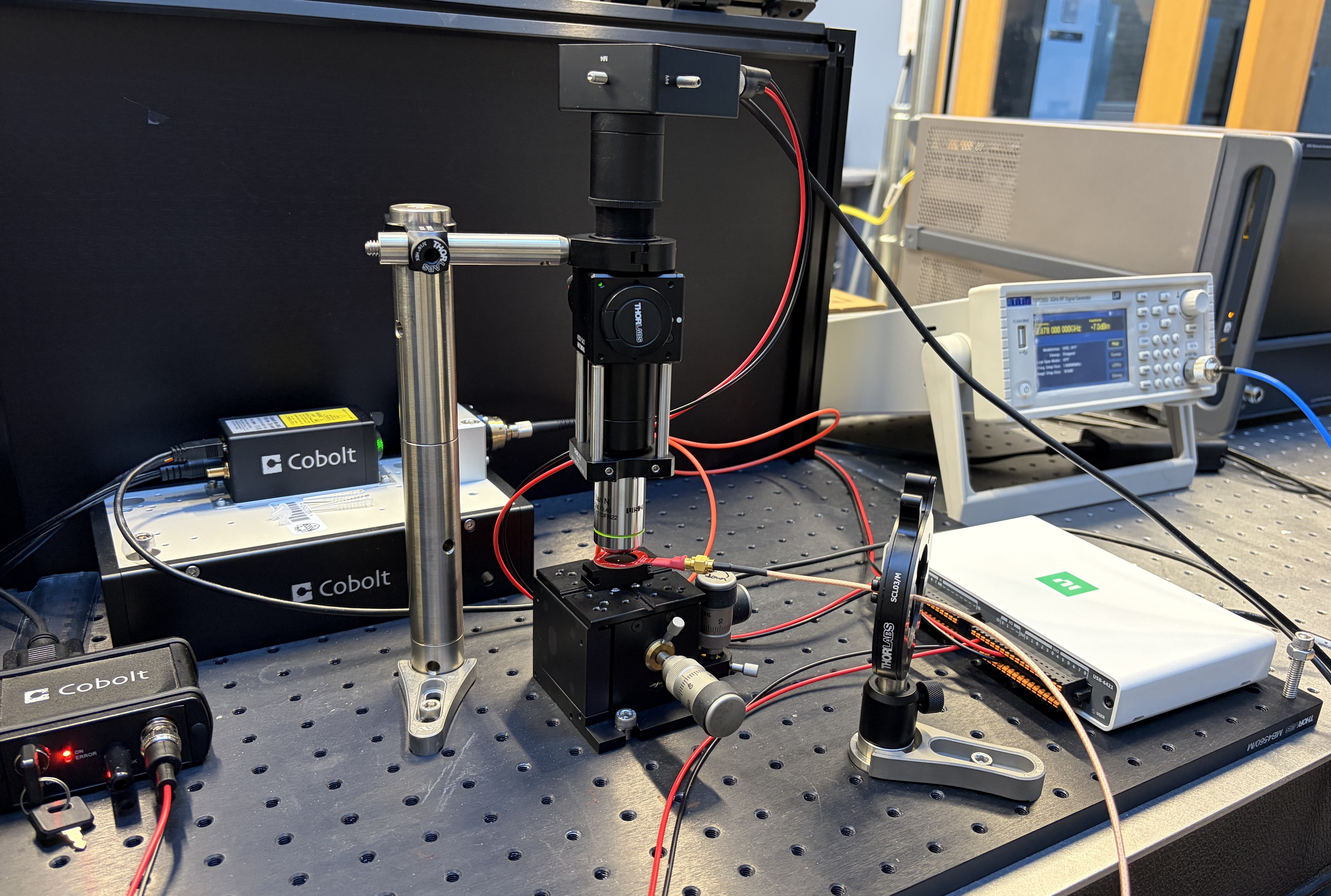
Current work focuses on establishing reproducible ODMR measurements on nanodiamond composites. This includes optimizing optical excitation, fluorescence collection, microwave delivery, and signal acquisition, together with reference measurements that separate resonance signals from background fluorescence, drift, and electrical interference. Resonance contrast, linewidth, signal stability, and measurement noise serve as the figures of merit for sensor performance, and magnetic and thermal contributions are distinguished through their different effects on the resonance spectrum.
Building on these measurements, the long-term objective is a compact NV-based quantum sensor for localized magnetic-field and temperature measurements in materials characterization, devices, and energy infrastructure.
Supported in part by the National Energy Technology Laboratory (NETL) through the Grid-Q project.