Project
Metal Amorphous Nanocomposite (MANC) Alloys and In-Line Manufacturing
Property tailoring through high heating rates and annealing times
Completed

Project
Property tailoring through high heating rates and annealing times
Completed
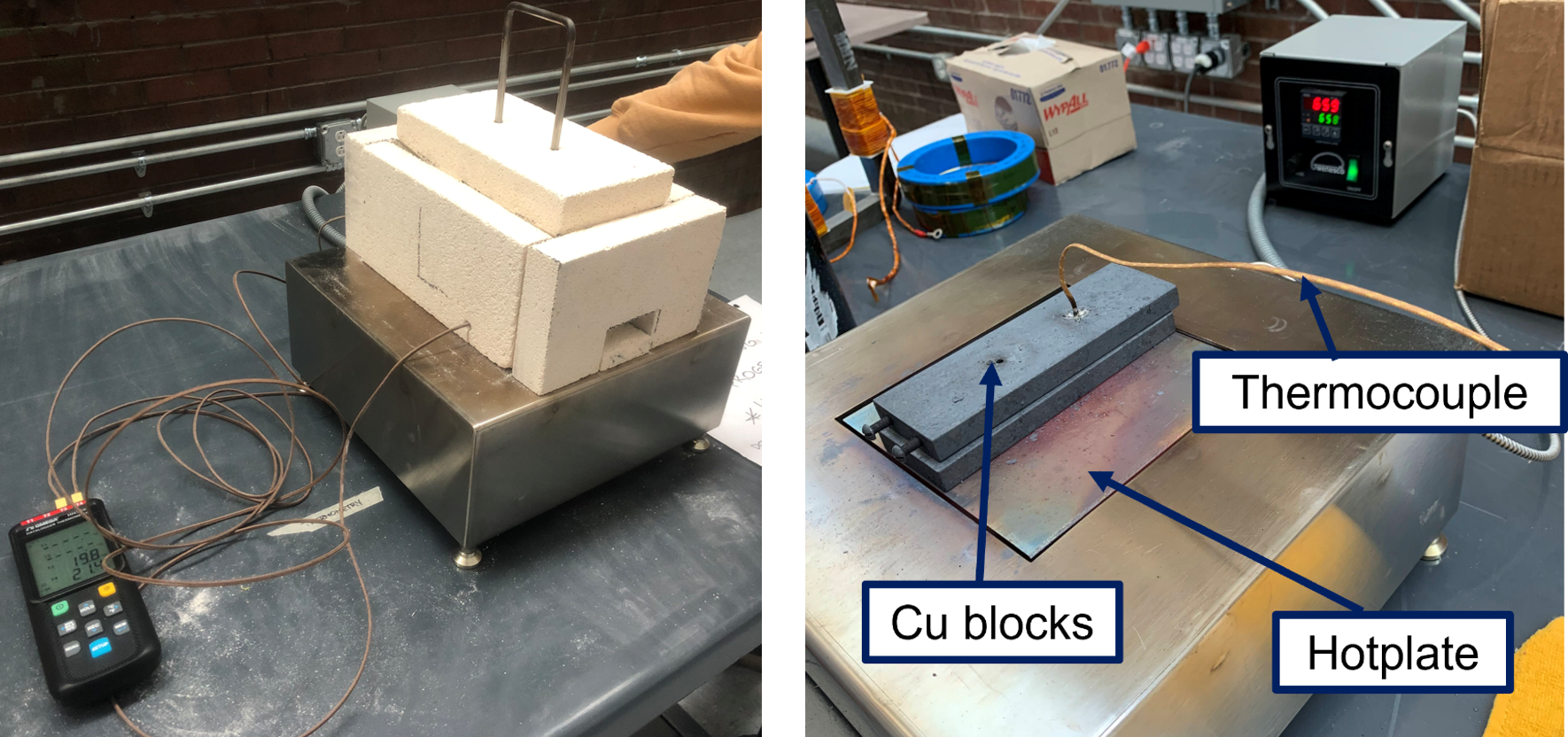
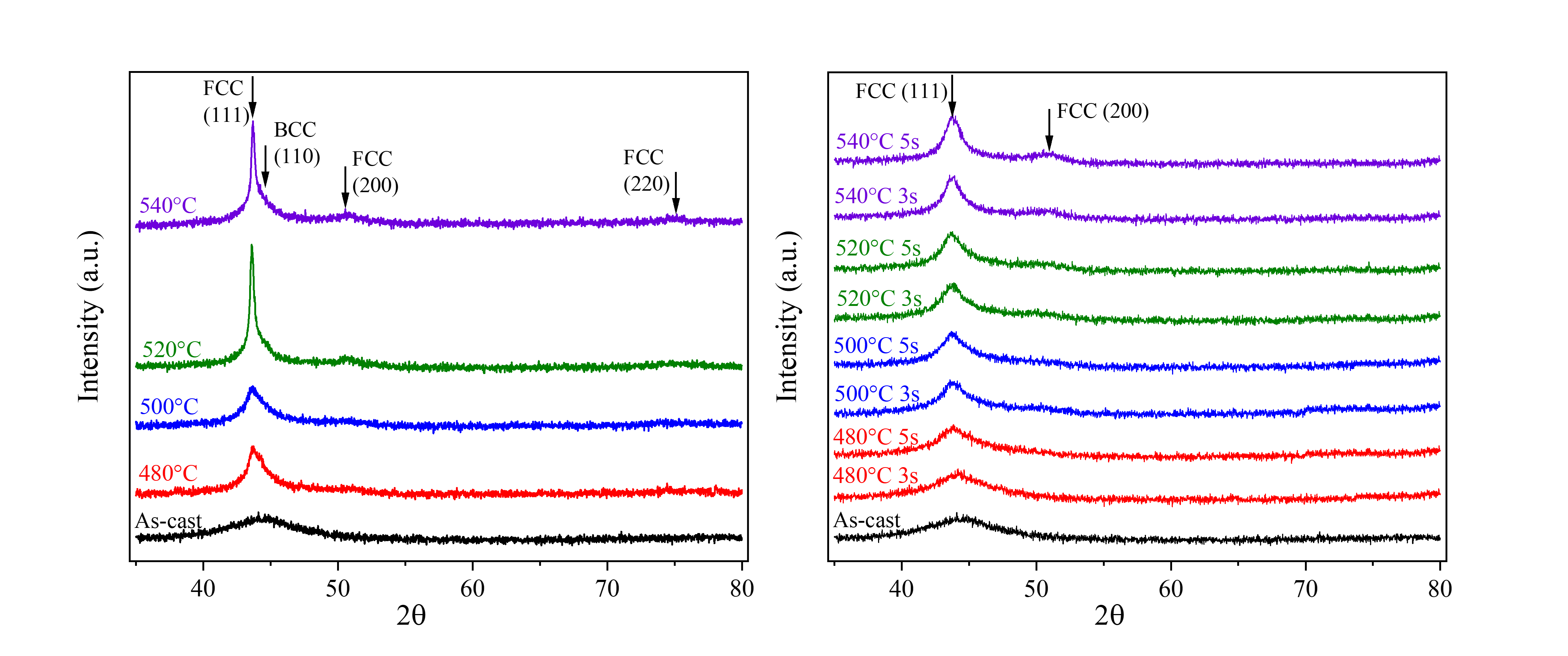
FeNi-based alloys, 20µm thick and 2.5cm wide were annealed with two different techniques to see property differences and ability to scale up. Conventional annealing used a preheated furnace at 480-540 °C for 30 min with air cooling. Flash annealing used a custom setup in which a ribbon was clamped between preheated, high-thermal-mass copper blocks for 1-7 s and then air quenched. Phase and grain structure were characterized by X-ray diffraction. Dynamic coercivity and permeability were measured at 2 kHz with a Brockhaus MPG 200 steel tester. Ductility was assessed with a newly designed semi-quantitative, scheme of shear cutting, manual tearing, and 180° bending, with five repeats per condition summed to a 0-45 brittleness score. Thermo-Calc Gibbs free energy calculations for the binary Fe-Ni system at 480 °C and above, using common and parallel tangent constructions, predicted FCC-dominant crystallization. Flash annealing gave FCC-dominant, finer-grained structures than conventional annealing. Coercivity decreased after flash annealing and remained ductile enough to wrap into a core. While conventional anneals increased coercivity and became too brittle to bend, restricting their use in continuous processing.
This research is based upon work supported by DARPA though CorePower Magnetics, Inc. under Contract Number HR001121C0094